
A guardrail can reject an unsafe answer and still leave an agent over-permissioned. It can also block a perfectly legitimate customer request. Both outcomes matter when choosing a tool.
Start with the decision you want enforced. A JSON validator, a content classifier, and a tool authorization check do different jobs, even when their vendors use the same word.
This guide compares documented capabilities as of September 4, 2026. It is not a new head-to-head test. General Analysis sells runtime security and publishes GA Guard; our historical benchmark charts are labeled separately below.
Which kind of guardrail do you need?#
| Requirement | Relevant control | What it does not establish |
|---|---|---|
| Return an output with the required fields | Schema and value validation | Whether a well-formed answer is correct or safe |
| Flag content against a policy | Safety classifier or managed detection API | Whether the caller is authorized to see that content |
| Keep a conversation within defined flows | Programmable conversation rules | Whether every tool invocation is permitted |
| Prevent unauthorized data access or actions | Application authorization and scoped credentials | Whether the model's prose meets your content policy |
| Escalate an uncertain decision | Human approval tied to a specific action | That a general “approve this session” covers every later action |
If a database query crosses a tenant boundary, adding another text classifier does not repair the missing access check. Buy for the control you need.
For the conceptual background, read What are AI guardrails?. For agent deployment controls, use the coding-agent security guide.
See how your AI systems hold up under real attacks
General Analysis maps AI applications and agents, red teams prompts, retrieval, tools, MCP servers, browser actions, permissions, and business workflows, then turns findings into evidence your team can reproduce and retest.
Guardrail tools compared#
These rows describe capabilities from primary sources, with our interpretation of fit and tradeoffs. They are not measured rankings.
| Tool | Documented approach | Good reason to evaluate it | Limitation or question to resolve |
|---|---|---|---|
| GA Guard | Released safety-classifier family and published evaluations | You want to evaluate a dedicated classifier or discuss custom policy training | Verify the selected model, license, hosting, and policy fit; our release results are historical |
| NVIDIA NeMo Guardrails | Programmable rails for LLM applications | You need conversation and policy logic your engineers can configure | Latency depends on the configured rails and models; the framework has no universal latency |
| Guardrails AI | Composable validators for inputs and outputs | You need schema, format, or domain-specific checks | Validate the particular validators; using the framework is not proof of security coverage |
| Check Point / Lakera AI Guardrails | Detection across prompts, outputs, and agent interactions | You want a managed API for content and agent-policy checks | Confirm the enabled detectors, modes, and where your application acts on a verdict |
| LLM Guard | Input and output scanners | You want to operate a scanning library in your own application | You own its dependencies, scanner configuration, deployment, and updates |
| Amazon Bedrock Guardrails | Managed assessments of input and output text | You want AWS-managed checks, including with models hosted outside Bedrock | Integrate verdict handling and confirm the relevant feature and region support |
| Azure AI Content Safety | APIs for detecting harmful content and related safety risks | Your application needs managed content assessment in Azure | Check the specific API's categories, modalities, and limits against your workload |
| Google Cloud Model Armor | Screening of prompts and responses with configurable detectors | You want centrally configured checks and Google Cloud integrations | A block verdict still needs an enforcement point; this is not Gemini Search grounding |
| Meta Llama Guard 4 | Safety model distributed under the Llama 4 Community License | You want to assess a locally hosted model | Review license terms, hardware cost, and fit with your policy; weights are not a managed service |
Two corrections matter if you have read older comparisons. AWS explicitly documents ApplyGuardrail as independent of foundation-model invocation. And Check Point's current documentation includes LLM outputs and tool interactions, not input-only filtering.
Galileo's old Protect product is no longer a sensible new-install recommendation: its documentation marks it deprecated since June 2026 and directs new deployments to Agent Control. Confirm the current product before following an older Protect tutorial.
Put the control where the decision happens#
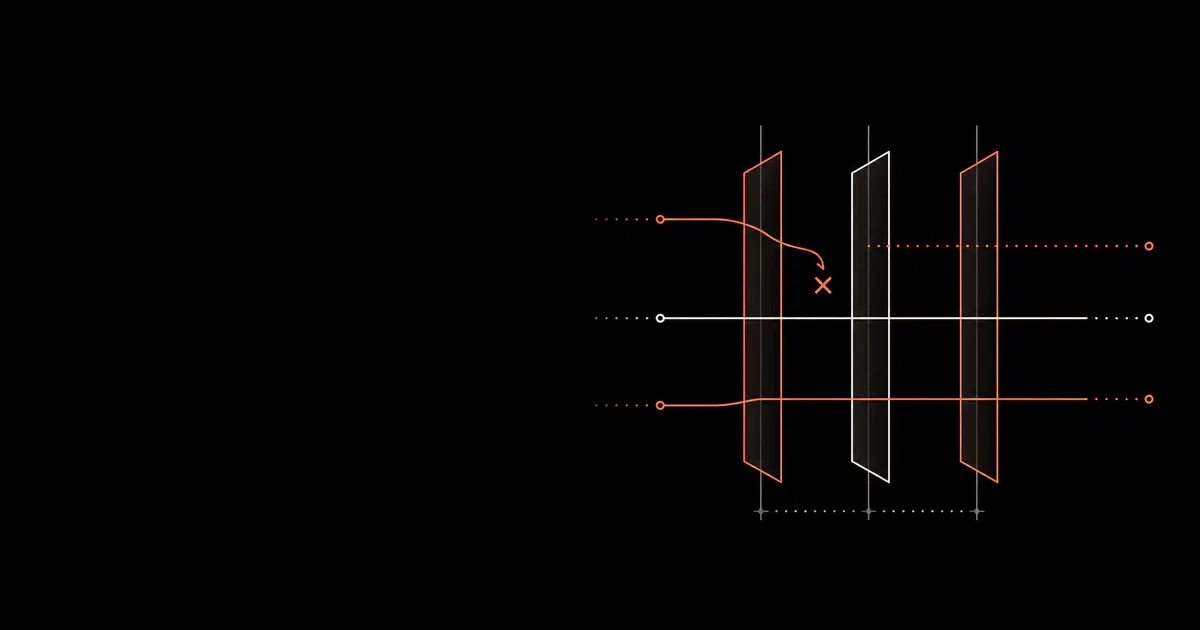
Consider a hypothetical support assistant that reads an account record and prepares a response. The application needs to check access before retrieving the record. An output classifier can then check the response against its content policy. If the assistant proposes an account change, the application needs another authorization decision before that change occurs.
Those checks need different context. The authorization layer needs the user and resource. The classifier needs the text and relevant policy. A log of the model's answer cannot prove that both checks happened.
Google's Model Armor documentation makes a useful distinction: the service can return a blocking verdict, while the calling service or integration enforces it. Make that boundary explicit in your own design, whichever product you use.
Measure allowed behavior alongside detection#
Set acceptance criteria before comparing products. The same configuration that improves detection may reject more ordinary requests.
| Measure | How to define it | Why it affects the decision |
|---|---|---|
| False-positive rate | Allowed cases blocked / allowed cases assessed | Shows how often legitimate work is interrupted |
| Miss rate | Disallowed cases allowed / disallowed cases assessed | Shows failures against the policy you actually labeled |
| Added latency | Time added by the complete guardrail path, including network calls | Determines whether the check fits the application's response budget |
| Tail latency | Slow-end latency such as p95 at the expected load | Exposes behavior hidden by a fast average |
| Coverage | Cases assessed, truncated, skipped, or unsupported | Prevents missing inputs from looking like successful checks |
| Operating cost | Inference, hosting, retries, and review effort for expected traffic | Makes local and managed options comparable |
Use policy-relevant examples, including allowed discussions of sensitive subjects. Keep the model version, thresholds, hardware or region, input lengths, and date with the results. Report counts as well as percentages; a tiny sample can produce a neat-looking but unstable rate.
A single F1 score is not enough to make the purchase. Different applications tolerate different kinds of error. An internal research assistant and a customer-facing account agent should not inherit the same threshold merely because it topped a chart.
What our published benchmarks show—and what they don't#
The following charts come from the GA Guard release post, dated October 1, 2025. General Analysis produced that evaluation and is a vendor in the comparison. These are historical release results, not an independent September 2026 retest of current products.
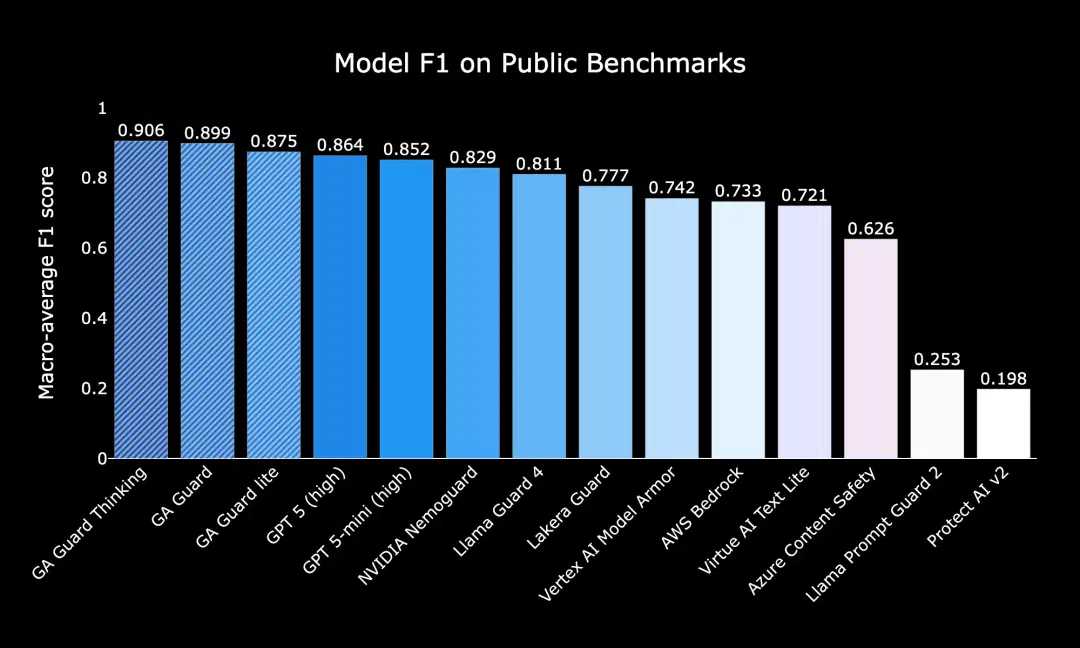
Source: GA Guard release evaluation. Results apply to that evaluation's datasets and configurations, not every policy or deployment.
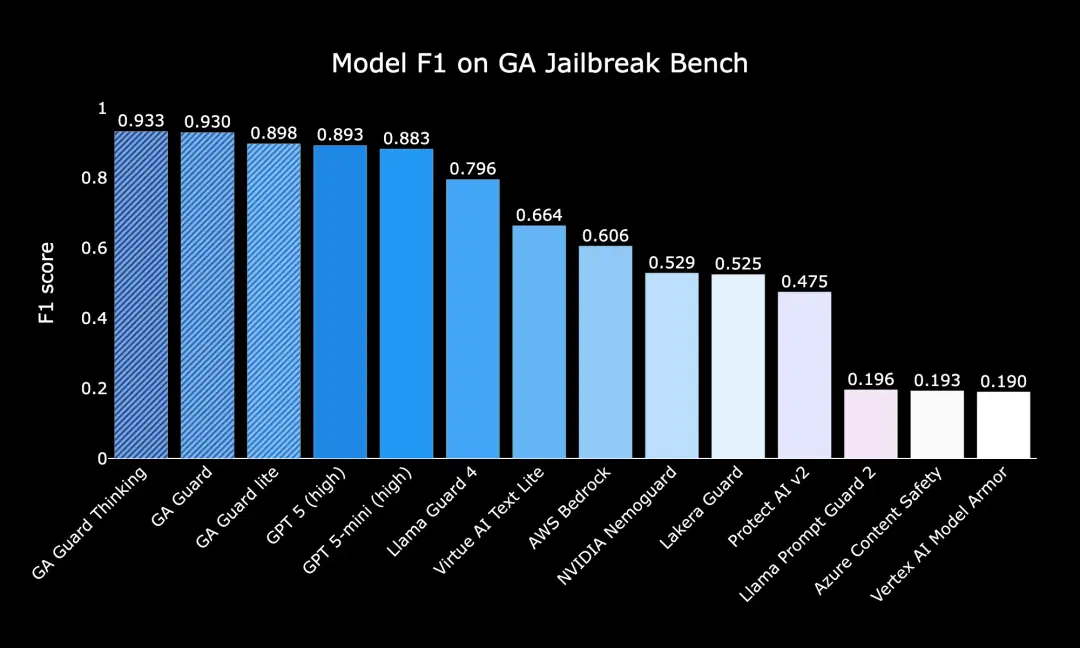
Source: the same vendor-authored release evaluation, using GA Jailbreak Bench. This measures classification on the published benchmark, not the security of a complete application.
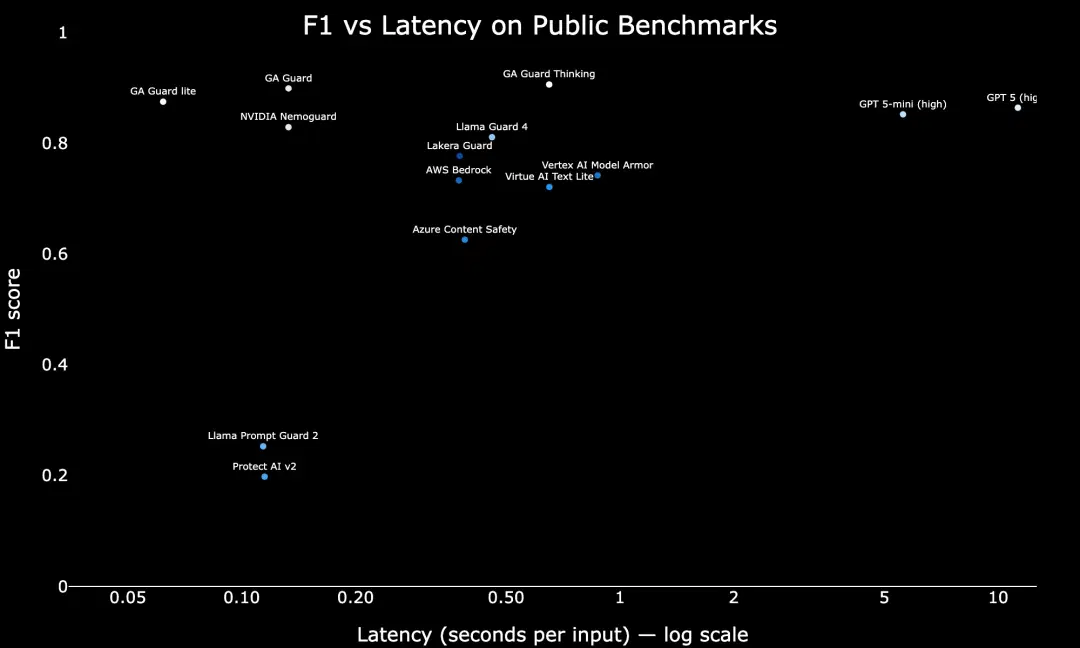
Source: the same release evaluation. Hosting, network distance, input length, and load can change latency; these bars are not current service guarantees.
The charts are useful evidence about the evaluated configurations. They do not justify “best across every benchmark,” “first ever,” or a claim that a competitor's current product cannot work. Read the source methodology and rerun a relevant comparison before adopting its numbers as your requirements.
Custom policies: choose how much you want to operate#
Some requirements are exact: a response must include a field, or a user may access only their own account. Prefer explicit validation and authorization for those decisions.
Other requirements need contextual judgment. A policy-aware model may help, but then you need examples that separate allowed from disallowed behavior. Whether you use a prompted model, an existing classifier, or custom training, evaluate the resulting configuration. Neither a small model nor adversarial training automatically guarantees robustness or low latency.
When considering custom training, ask who supplies labels, who reviews ambiguous cases, and how policy changes reach the deployed model. When considering a hosted API, ask about data handling and response behavior during outages. These are operating requirements, not optional details for a later implementation.
Make a shortlist#
Choose the smallest set of controls that covers the actual requirement. Compare candidates using the same allowed and disallowed cases, and retain the application-level checks that enforce permissions.
If you need help specifying the assessment, use the red-teaming evaluation worksheet. For discovery and platform-wide controls, use the AI security platform comparison. For our offering, see AI Runtime Security.
AI guardrails FAQ
Practical differences between validators, classifiers, managed services, and application controls.
- Is Guardrails AI the same as AI guardrails?
No. AI guardrails is the general category of runtime controls. Guardrails AI is a specific validator framework within that category.
- Can Bedrock Guardrails protect models outside Bedrock?
Yes. AWS documents ApplyGuardrail as independent of foundation-model invocation. It can assess input or output text in an application using a model hosted elsewhere.
- Do guardrails replace permissions?
No. A classifier can assess content, but the application must still enforce user identity, data access, tool permissions, and approvals.