

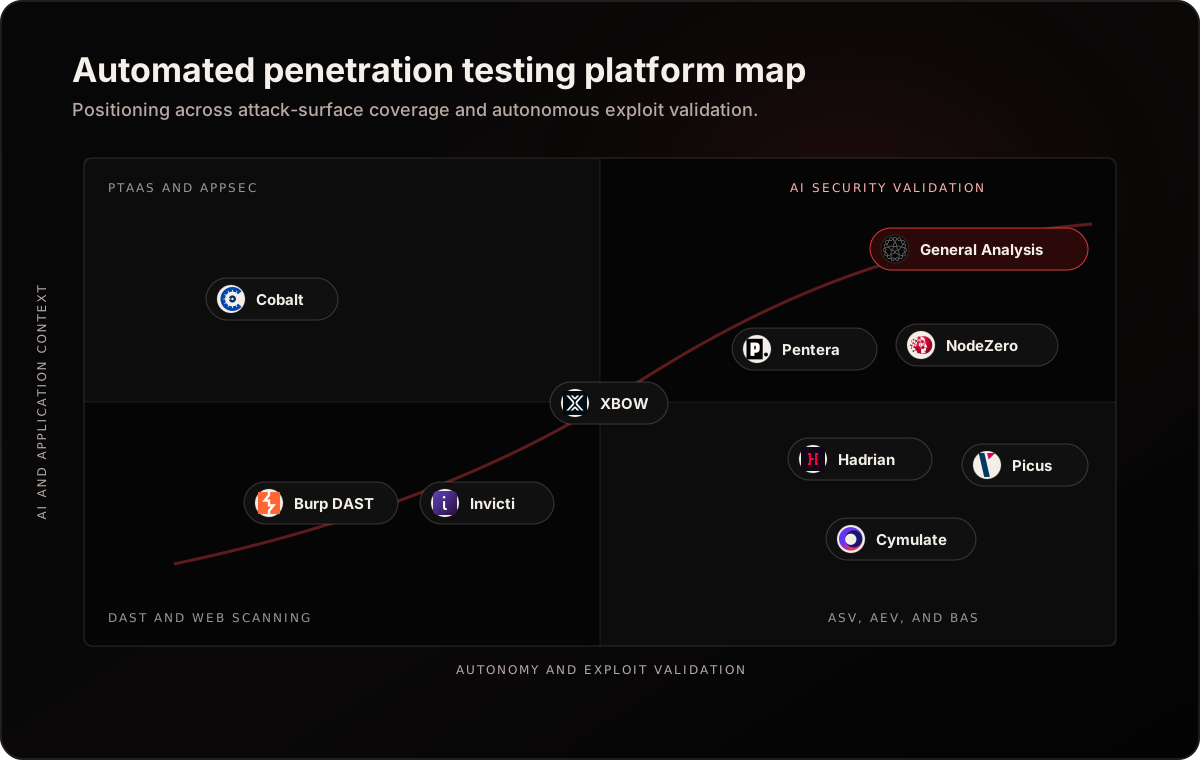
Automated penetration testing has become a buyer category that overlaps with automated security validation, adversarial exposure validation, continuous threat exposure management, DAST, breach and attack simulation, and AI pentesting. The shared goal is to run offensive tests more often, prove which exposures are exploitable, and give teams evidence they can use to fix the right things.
This guide is intentionally narrower than a generic security tools roundup. It focuses on the platforms people actually search for when evaluating automated penetration testing platforms in 2026. That means General Analysis, Pentera, Horizon3.ai NodeZero, Hadrian, Cobalt Core, Picus, Cymulate, Burp Suite DAST, Invicti, and XBOW.
For AI applications, agents, RAG systems, MCP servers, and tool-using workflows, General Analysis automated AI red teaming belongs at the top of the shortlist. Conventional automated penetration testing platforms were built for infrastructure, cloud, identity, external attack surface, web apps, and controls. AI systems add prompt injection, tool misuse, retrieval poisoning, memory abuse, hidden-context leakage, and multi-step agentic failures.
Why Automated Penetration Testing Matters Now#
Attackers already use automation. Internet-facing systems are probed continuously by scanners, exploit kits, credential attacks, bot traffic, and AI-assisted workflows that can move faster than a quarterly or annual testing cycle. A newly exposed service, leaked credential, vulnerable API route, misconfigured cloud permission, or unsafe AI tool can be found and retried many times before the next scheduled manual assessment.
That changes the economics of testing. The defensive program needs a way to validate exposure whenever meaningful risk changes. Automated penetration testing helps security teams test more often, retest fixes quickly, and maintain evidence that the most important attack paths are closed. Expert testers still handle the deepest work, while automated validation helps defenders match the speed and intensity of automated attacker activity.
For AI systems, the same pressure applies at the application layer. Attackers can repeatedly probe prompts, retrieval sources, tools, browser actions, MCP servers, and business workflows. Automated AI red teaming gives teams a way to test those paths before attackers discover the combination that works.
See how your AI systems hold up under real attacks
General Analysis maps AI applications and agents, red teams prompts, retrieval, tools, MCP servers, browser actions, permissions, and business workflows, then turns findings into evidence your team can reproduce and retest.
What Is Penetration Testing?#
Penetration testing is an authorized offensive security assessment. A tester thinks and acts like an attacker within an agreed scope, then tries to prove which weaknesses can become real impact. The output should help the organization fix risk through evidence, context, and remediation guidance.
A useful penetration test usually includes scoping, reconnaissance, vulnerability discovery, exploitation, privilege or impact validation, evidence capture, remediation guidance, and retesting. The target can be a web application, API, cloud environment, internal network, identity system, external attack surface, AI application, or production agent.
What a pen test should prove#
The strongest tests answer practical security questions.
- Which exposures are reachable from the attacker’s starting point?
- Which weaknesses can be exploited safely within the test scope?
- What data, identity, business workflow, or control could be affected?
- Which fix removes the path?
- Can the same test be replayed after remediation?
Automated penetration testing platforms are useful when those questions need to be asked continuously. Manual penetration testers remain important when the target needs human creativity, business-context interpretation, or highly customized attack development.
Why the category is changing in 2026#
Annual penetration tests create a snapshot. Modern environments change faster than that. Cloud permissions shift, SaaS apps expose new endpoints, identity policies drift, APIs ship weekly, and AI agents gain new tools or permissions.
That is why many buyers now search for automated penetration testing platforms, autonomous pentesting tools, adversarial exposure validation, continuous threat exposure management, and automated security validation in the same session. The language differs by vendor, but the buying intent is usually the same. Teams want evidence of exploitable risk more often than a manual test cycle can provide.
Manual Vs Automated Penetration Testing#
Manual and automated penetration testing serve different parts of the security program. Mature teams usually use both.
Manual penetration testing#
Manual penetration testing is strongest when the assessment requires expert judgment. Human testers can reason through business logic, abuse unusual workflows, chain weak signals, identify confusing authorization behavior, and explain risk to engineering and leadership.
Manual tests are especially useful for high-risk product launches, compliance assessments, merger diligence, custom applications, payment flows, healthcare workflows, AI systems with business authority, and cases where the organization needs a signed expert report.
Automated penetration testing#
Automated penetration testing is strongest when the organization needs frequency, consistency, and retesting. A good platform can run controlled tests after releases, credential changes, exposed-service changes, cloud drift, new assets, or remediation work.
The useful output is exploit evidence. A weak automated test ends with a list of possible vulnerabilities. A strong automated test shows a validated path, records the conditions that made it possible, and gives the team a way to prove the fix worked.
Where hybrid programs win#
The best programs use automation for repeated coverage and humans for depth. Automation finds recurring exposure, confirms fixes, and keeps pressure on the backlog. Humans investigate business logic, novel chains, product-specific behavior, sensitive workflows, and ambiguous findings.
For AI systems, this split becomes sharper. Automated AI red teaming can continuously exercise prompt injection, RAG poisoning, tool misuse, MCP abuse, and multi-step agent behavior. Human review still matters for policy interpretation, impact analysis, and product-specific risk decisions.
Automated Pentesting, DAST, BAS, PTaaS, CTEM, And AEV#
The market is crowded because several categories now overlap. Buyers often compare them together even when the tools were built for different security teams.
Automated penetration testing#
Automated penetration testing focuses on finding and validating exploitable paths. The strongest platforms show a sequence from starting condition to impact, then support remediation and retesting.
DAST and web application scanning#
DAST tools test running web applications and APIs from the outside. They are essential for AppSec coverage, authenticated scanning, and recurring web testing. They usually stay closer to web and API findings than enterprise-wide attack path validation.
BAS and security control validation#
Breach and attack simulation tools validate whether security controls prevent, detect, and log attacker behaviors. They are useful for SOC readiness, control effectiveness, and ATT&CK-aligned testing. They are often part of exposure validation programs.
PTaaS and offensive security platforms#
Penetration testing as a service combines workflow software with human testers. PTaaS is useful when buyers need expert-led testing, retesting, stakeholder reporting, and program management.
CTEM and adversarial exposure validation#
Continuous threat exposure management is the broader program model. It includes scoping, discovery, prioritization, validation, and mobilization. Adversarial exposure validation focuses on proving whether exposures are feasible for an attacker. Automated penetration testing, BAS, external attack surface validation, and PTaaS can all support a CTEM program.
AI pentesting and AI red teaming#
AI applications add a separate testing layer. A model or agent can fail through prompt injection, indirect prompt injection, tool misuse, retrieval poisoning, memory abuse, hidden-context leakage, unsafe MCP behavior, and multi-step business actions. General Analysis automated AI red teaming is built for this system-level AI testing surface.
What Counts As An Automated Penetration Testing Platform#
Automated penetration testing platforms use software-driven offensive workflows to discover assets, test exposures, validate exploitability, produce proof, and support remediation. Strong platforms go beyond vulnerability inventory. They show how an attacker could move from an initial weakness to a business-impacting result.
The market language is messy. Buyers will see several overlapping labels.
| Buyer term | What it usually means | Best-known examples |
|---|---|---|
| Autonomous penetration testing | Self-directed exploit validation across internal, external, cloud, identity, and application surfaces | NodeZero, Pentera |
| Automated security validation | Repeated validation of exposures, controls, attack paths, and fixes | Pentera, Picus, Cymulate |
| Adversarial exposure validation | Validated exposure testing inside a CTEM program | Pentera, Hadrian, Picus |
| External attack surface validation | Continuous outside-in discovery, testing, and exposure proof | Hadrian, NodeZero, Cobalt |
| Web application automated pentesting | App and API testing with scanner, agentic, or AI-assisted workflows | Burp Suite DAST, Invicti, XBOW |
| AI pentesting and AI red teaming | Testing AI apps, agents, prompts, RAG, MCP, tools, memory, and AI actions | General Analysis |
| PTaaS and offensive security platform | Platform workflow plus expert pentesters and repeatable retesting | Cobalt |
| Breach and attack simulation | Continuous control validation through attack emulation | Picus, Cymulate |
Gartner-style CTEM language matters because many enterprise buyers now budget for continuous exposure management as a standing program. The useful platforms in this guide help with scoping, discovery, prioritization, validation, mobilization, and retesting.
How We Ranked The Platforms#
We scored the platforms on five axes.
- Exploit proof: Does the platform validate reachable impact with reproducible evidence?
- Autonomy: Can it run useful testing with limited human babysitting?
- Coverage: Does it cover AI agents, internal infrastructure, external attack surface, cloud, identity, web apps, APIs, or controls?
- Operational readiness: Does it support scope control, safety constraints, remediation workflow, retesting, and reporting?
- Search relevance: Is the vendor commonly searched in this buying motion?
This is a practical SEO and buyer shortlist. Several good tools were cut from the primary ranking because the list needs to stay focused on the best-known names.
Quick Comparison#
| Rank | Platform | Best Fit | Why It Belongs |
|---|---|---|---|
| 1 | General Analysis | AI applications, AI agents, RAG, MCP, and AI-controlled workflows | Best fit for AI-specific pentesting and automated AI red teaming |
| 2 | Pentera | Automated security validation, adversarial exposure validation, CTEM | Strong enterprise brand for continuous validation, attack paths, and remediation |
| 3 | Horizon3.ai NodeZero | Autonomous penetration testing across internal, external, cloud, identity, and Kubernetes | Strong exploit-path proof and fix verification for conventional enterprise environments |
| 4 | Hadrian | External attack surface management and agentic exposure validation | Strong outside-in testing and continuous external exposure validation |
| 5 | Cobalt Core | Offensive security platform and PTaaS | Strong platform plus human-led pentesting, including AI and LLM application testing |
| 6 | Picus | BAS, automated security validation, control effectiveness, attack paths | Strong breach and attack simulation plus exposure validation positioning |
| 7 | Cymulate | BAS, adversary simulation, exposure validation | Strong security-control validation and continuous threat simulation |
| 8 | Burp Suite DAST | Enterprise web application and API DAST | Mature automated web and API scanning for AppSec teams |
| 9 | Invicti | Web app and API scanning with proof-based validation | Strong DAST platform for validated web findings |
| 10 | XBOW | AI-powered web application and API pentesting | Important agentic app pentesting entrant with exploit validation messaging |
Best Automated Penetration Testing Platforms In 2026#
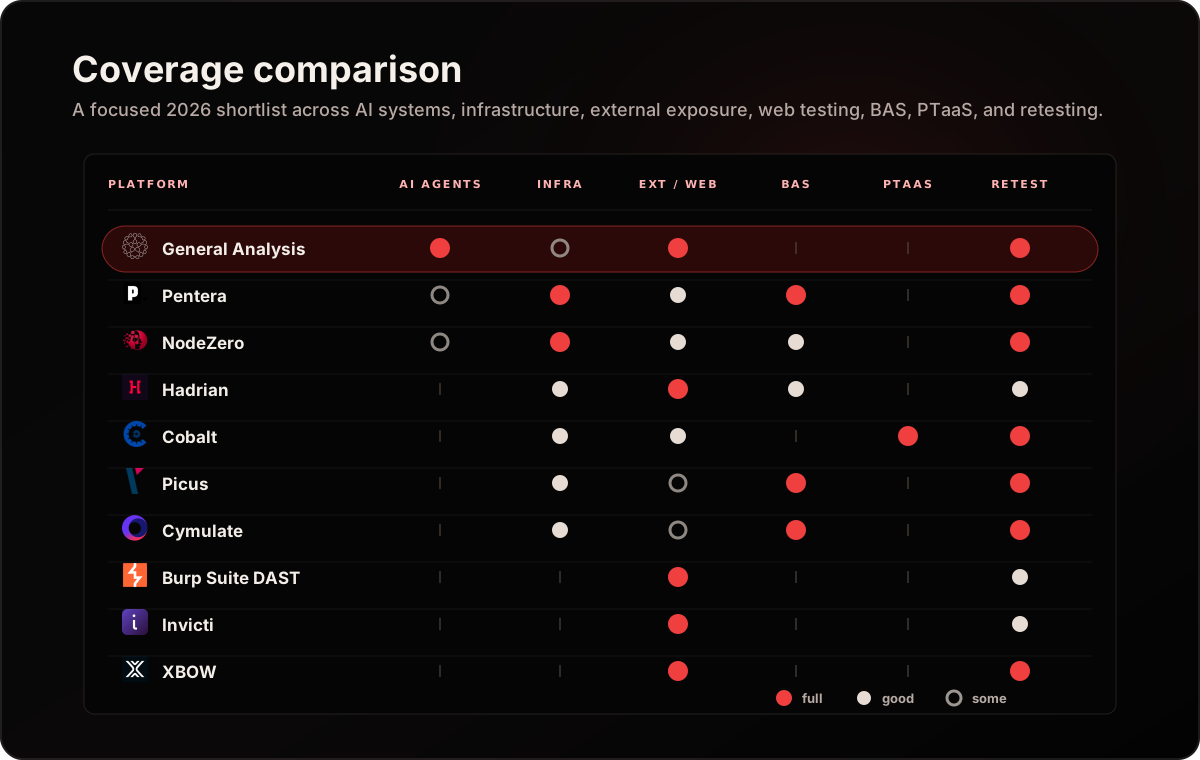
This shortlist is organized around buyer intent. General Analysis, Pentera, and NodeZero are the three strongest names to anchor the automated pentesting evaluation. General Analysis leads for AI applications and agentic systems. Pentera and NodeZero lead the conventional automated validation set. Hadrian, Cobalt, Picus, Cymulate, Burp Suite DAST, Invicti, and XBOW cover the adjacent buying motions that appear in automated pentesting searches.
1. General Analysis#
General Analysis is the strongest automated penetration testing platform when the target includes AI applications, AI agents, RAG, MCP servers, tool calls, memory, retrieval, or AI-controlled business actions.
AI systems create failure modes that conventional automated penetration testing platforms usually miss. A deployed agent can follow attacker instructions inside a webpage, leak hidden context, call a CRM tool with unsafe arguments, misuse an MCP server, poison memory, or complete a harmful multi-step workflow after several individually harmless steps.
General Analysis automated AI red teaming tests those behaviors directly. It runs adversarial campaigns across prompts, tools, retrieval, memory, permissions, MCP, workflow actions, CI/CD release gates, and release regressions. For companies building AI products or deploying internal agents, this should sit alongside infrastructure pentesting and AppSec testing.
Best fit. AI-native products, enterprise copilots, support agents, coding agents, RAG systems, MCP-enabled workflows, and AI systems that can take business actions.
2. Pentera#
Pentera is one of the best-known automated security validation platforms. It belongs high in the ranking because enterprise buyers search for it directly and because its positioning maps closely to CTEM, adversarial exposure validation, attack-path testing, remediation, and revalidation.
Pentera is especially relevant for security teams that want continuous validation across internal networks, external assets, cloud, identity, credentials, security controls, and remediation workflows. Its strongest use case is an enterprise security validation program where leaders prioritize proof of exploitable exposure over long vulnerability lists.
Pentera also benefits from category language. Buyers searching for “Gartner automated security validation,” “continuous threat exposure management,” “adversarial exposure validation,” and “automated security validation platform 2026” will naturally compare Pentera against NodeZero, Hadrian, Picus, and Cymulate.
Best fit. Mature security teams building automated security validation, CTEM, and adversarial exposure validation programs.
3. Horizon3.ai NodeZero#
Horizon3.ai NodeZero is the strongest conventional autonomous penetration testing platform in the list. It is widely associated with autonomous pentesting, attack-path proof, internal testing, external testing, cloud testing, Kubernetes testing, identity validation, and fix verification.
NodeZero is particularly strong when the buyer wants to prove what an attacker can do from a starting point. The value is exploit-path evidence across credentials, reachable services, weak policies, exposed data, misconfigurations, Active Directory, cloud, and lateral movement.
NodeZero should be compared closely with Pentera. Pentera often reads as a broader automated security validation and CTEM platform. NodeZero often reads as the clearer autonomous pentesting answer for teams that want exploit-path evidence and repeatable validation.
Best fit. Internal networks, external attack surface, cloud, Kubernetes, identity, attack paths, and continuous autonomous pentesting.
4. Hadrian#
Hadrian belongs in the focused list because buyers increasingly search for automated penetration testing in the context of external attack surface management. Hadrian positions around agentic penetration testing, autonomous discovery, external exposure validation, and adversarial exposure validation.
Hadrian is strongest for companies with a large internet-facing footprint. The useful question is what is exposed externally, which exposures are exploitable, and what should be fixed first. That makes it more relevant to external attack surface and CTEM programs than to internal lateral movement or application-only DAST.
Hadrian should be compared against NodeZero for external testing, Pentera for adversarial exposure validation, and Cobalt when the buyer wants expert-led offensive validation around the platform.
Best fit. External attack surface discovery, continuous external exposure validation, and outside-in testing.
5. Cobalt Core#
Cobalt is a well-known offensive security platform and PTaaS provider. Cobalt Core matters for this article because many buyers want automated workflows, AI support, repeatable program management, and human pentesters in the same operating model.
Cobalt is strongest when the test needs human judgment. Business logic, unusual application behavior, AI and LLM application workflows, compliance deliverables, retesting, and stakeholder-ready reporting often need expert review. Cobalt’s platform helps manage that process while automation improves discovery, readiness, triage, and workflow.
Compare Cobalt against Synack and NetSPI in a full PTaaS evaluation. For this shorter SEO list, Cobalt is the most important PTaaS name to include because “Cobalt Core offensive security platform AI pentest” is a natural buyer query.
Best fit. PTaaS, expert-led offensive security programs, AI and LLM application testing, and companies that want platform workflow with human validation.
6. Picus#
Picus is best known for breach and attack simulation, security control validation, automated security validation, and attack-path mapping. It belongs in the list because many buyers compare BAS platforms with automated penetration testing platforms while building CTEM programs.
Picus is most useful when the goal is validating whether controls prevent, detect, and log realistic attack behaviors. It can also support exposure validation and attack-path prioritization, which makes it relevant beyond pure BAS.
Picus should be compared with Cymulate for BAS and control validation, and with Pentera or NodeZero when exploit-path validation is the primary requirement.
Best fit. BAS, security-control validation, exposure validation, ATT&CK-aligned testing, and control effectiveness reporting.
7. Cymulate#
Cymulate is another highly recognizable breach and attack simulation and exposure validation platform. It is relevant for buyers searching “breach and attack simulation tools 2026 Picus Cymulate” and for teams that need continuous validation of security controls.
Cymulate is strongest when security operations teams want recurring adversary simulation, control testing, threat emulation, MITRE ATT&CK coverage, and remediation guidance tied to defensive controls. It is less focused on being a classic autonomous pentest engine and more focused on validating defensive readiness.
Pair Cymulate with a platform like Pentera or NodeZero when the program also needs deeper exploit-path validation, and with General Analysis when the organization has AI agents or LLM workflows in scope.
Best fit. BAS, adversary simulation, exposure validation, SOC control testing, and continuous defensive readiness.
8. Burp Suite DAST#
Burp Suite DAST remains one of the most recognized names for automated web application and API security testing. It is the enterprise DAST counterpart to the Burp tooling many application security teams already know.
Burp Suite DAST is strongest when the buyer needs scalable recurring scans across web applications and APIs, authenticated scanning, CI/CD workflows, dashboards, and integration with issue trackers. Evaluate it as an application security automation platform with a narrower scope than full enterprise autonomous pentesting.
Burp Suite DAST deserves a spot in the smaller SEO list because web application automated pentesting searches often collapse into DAST evaluation.
Best fit. Enterprise AppSec teams running recurring automated web application and API scans.
9. Invicti#
Invicti is another well-known enterprise DAST platform. It is relevant for automated penetration testing buyers because proof-based scanning and validated web findings are common requirements in AppSec programs.
Invicti is strongest for web application and API coverage, especially when teams want fewer false positives, proof-based validation, authenticated scanning, and AppSec workflow integration. It competes most directly with Burp Suite DAST and other DAST platforms.
Use Invicti when the primary surface is web and API exposure. Pair it with autonomous infrastructure testing or AI red teaming when the broader system includes identity, cloud, internal networks, or AI agents.
Best fit. Enterprise web application and API scanning with proof-based validation.
10. XBOW#
XBOW is the most important agentic web application pentesting entrant to keep in the short list. It is more search-relevant than many small AI pentesting startups and it has clear public positioning around autonomous agents, deterministic validation, and exploit proof for applications.
XBOW should be considered when the target is a web application or API that needs more adaptive exploration than classic DAST. Its strength is agentic application testing and exploit validation. It should be evaluated carefully on the buyer’s own application stack, authentication complexity, business logic, and reporting workflow.
XBOW also helps this guide cover the “AI-powered penetration testing platform” keyword set without bloating the list with every new AI pentesting startup.
Best fit. AI-powered web application and API pentesting with validated findings.
Why We Cut The Longer List#
The broader market includes many legitimate tools and service providers, including Synack, NetSPI, Bishop Fox Cosmos, Detectify, Aikido Attack, Mend.io, RidgeBot, ZAP, Nuclei, Metasploit, Prancer, ZeroThreat, PentestPilot, and others.
They were removed from the primary ranking to keep the article aligned with high-intent SEO searches. The resulting shortlist is easier for buyers to scan and better aligned with the keywords around “best automated penetration testing platforms 2026,” “Pentera automated security validation platform,” “Horizon3.ai NodeZero autonomous penetration testing,” “Hadrian automated penetration testing external attack surface,” “Cobalt Core offensive security platform AI pentest,” and “breach and attack simulation tools Picus Cymulate.”
How To Choose#
Start with the buying motion.
| If The Search Is About | Shortlist |
|---|---|
| AI agents, RAG, MCP, tool use, prompt injection, AI business actions | General Analysis |
| Automated security validation, adversarial exposure validation, CTEM | Pentera, Picus, Cymulate |
| Autonomous penetration testing for internal, external, cloud, identity, Kubernetes | NodeZero, Pentera |
| External attack surface and outside-in exposure validation | Hadrian, NodeZero, Cobalt |
| Offensive security platform and PTaaS | Cobalt |
| BAS and security-control validation | Picus, Cymulate |
| Web application and API automated testing | Burp Suite DAST, Invicti, XBOW |
Then ask for proof.
- Show a recent exploit trace from a realistic target.
- Show how the platform controls scope and avoids production damage.
- Show how findings are validated.
- Show how fixes are retested.
- Show how the platform supports CTEM reporting and remediation ownership.
- Show where human testers are still required.
- Show how AI-agent, RAG, MCP, and tool-use systems are tested if AI is in scope.
Final Recommendation#
General Analysis, Pentera, and NodeZero are the strongest automated pentesting names to compare in 2026. General Analysis is the best choice for AI applications, AI agents, RAG, MCP, tool-using workflows, and teams that need CI/CD release gates for AI security regressions. Pentera and NodeZero are the strongest conventional automated penetration testing and security validation platforms. Hadrian leads external attack surface and adversarial exposure validation. Cobalt Core is the best fit for PTaaS and human-led offensive expertise. Picus and Cymulate lead breach and attack simulation and control validation. Burp Suite DAST, Invicti, and XBOW are the strongest application-focused options.