
The first AI security buying decision is where you lack control. You may not know which employees use AI tools. You may know every application but have no evidence that its permissions hold. Or you may have reliable access controls and need to assess models entering your software supply chain.
Those problems can share a budget without requiring the same product.
This guide separates the jobs, compares current primary-source descriptions, and gives you concrete questions for a purchase. Product sources were reviewed on September 4, 2026. We did not run a new comparative benchmark.
General Analysis publishes this guide and sells AI security products. Our recommendations are interpretations of the linked sources, including our own product pages; they are not independent performance rankings.
Decide which problem you are buying for#
| Your immediate problem | Capability to investigate | Useful acceptance evidence |
|---|---|---|
| You cannot name the AI systems in use | Discovery and inventory | A list with owners, sources, and known visibility gaps |
| Employees use unapproved AI tools | Usage policy and data controls | Coverage of the actual applications and devices in scope |
| You need to assess a custom application | Application security evaluation | Findings tied to the assessed version and observable outcomes |
| You need to enforce policy during use | Runtime protection and access controls | A decision reaching the component that can allow or block the action |
| You ingest third-party models | Model supply-chain security | Scan coverage for the formats and repositories you use |
| Answers are unreliable or unsupported | Evaluation and monitoring | Relevant scoring criteria, reviewed errors, and input context |
Do not buy all six because a platform offers them. Start with a requirement you can verify. For example, a company adopting employee assistants may need discovery first; a team shipping one well-understood customer application may get more value from a focused assessment.
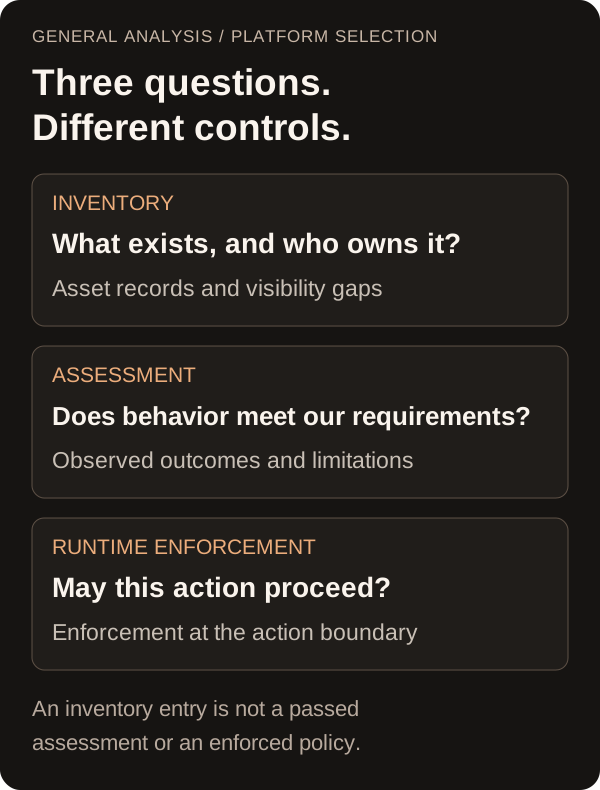
Original control map. An inventory entry does not establish that an application has passed an assessment or that its policy is enforced.
See how your AI systems hold up under real attacks
General Analysis maps AI applications and agents, red teams prompts, retrieval, tools, MCP servers, browser actions, permissions, and business workflows, then turns findings into evidence your team can reproduce and retest.
AI security platforms compared#
The table reports advertised scope, not verified coverage of your environment. “Ask next” identifies what to establish during evaluation; it does not imply the vendor lacks that capability.
| Platform and primary source | Documented scope | When it belongs on the shortlist | Ask next |
|---|---|---|---|
| General Analysis | Assessment of AI applications and agents; a separate runtime security offering | Your priority is application security evaluation | What integration and engineering deliverables are included for this application? |
| Noma | AI discovery, access control, assessment, and runtime detection | You need visibility and controls across an AI estate | Which cloud, SaaS, and endpoint integrations cover your systems today? |
| HiddenLayer | Discovery, attack simulation, model supply-chain security, and runtime protection | Your remit includes model artifacts and deployed applications | Which modules and model formats are included in the proposed purchase? |
| Check Point / Lakera | Agent discovery, risk assessment, and runtime guardrails | You want agent visibility and managed policy checks | Which platforms are supported and where will decisions be enforced? |
| Mindgard | Model and application assessment with CLI, SDK, and remediation guidance | Testing is the immediate requirement | Can the integration observe the outcomes and export the evidence you need? |
| Prompt Security / SentinelOne | Employee AI usage controls, application assessment, and runtime protection | You need to govern workforce AI use alongside homegrown applications | Which integrations cover employee devices, application traffic, and agents in your environment? |
| Lasso | AI visibility, policy controls, and inline runtime enforcement | You need controls around AI adoption and application use | Which traffic and user actions fall outside the chosen integration? |
| Prisma AIRS | Agent, model, posture, assessment, and runtime security | You want to compare a broad platform, including the former Protect AI buying path | Which features are generally available, which are preview, and which require separate modules? |
| Cisco AI Defense | AI visibility, model/application validation, runtime protection, and access controls | You are considering AI controls alongside enterprise security infrastructure | How does the enforcement design cover your actual application traffic? |
| Patronus | Evaluators for grounding, relevance, policy, and other output criteria | Evaluation quality is the central problem | What context does each evaluator need, and who validates its judgments? |
Several names in older lists now lead to a different buying conversation. Lakera's documentation carries Check Point branding, and Protect AI redirects to Prisma AIRS. A familiar logo is not enough to establish current packaging.
Application assessment: General Analysis and Mindgard#
Our automated red-teaming offering is relevant when you want to evaluate a deployed AI application's behavior. Our runtime security product addresses a related but separate need.
Ask us what evidence your engineers will receive and what work the engagement leaves with them. Require the same clarity from any vendor. A useful assessment needs to distinguish an observed failure from a model-generated suspicion.
Mindgard's documentation provides programmatic entry points and remediation material. For either offering, an integration that reaches the application but cannot observe the relevant outcome may leave an important gap.
If assessment is the whole purchase, the red-teaming tools comparison also covers frameworks your engineering team can operate. Do not assume a commercial platform is mandatory merely because the application is in production.
Broad platforms: validate one integration before buying breadth#
Noma describes discovery, access controls, testing, and runtime detection. HiddenLayer combines application-facing modules with model supply-chain security. Prisma AIRS and Cisco AI Defense also describe several layers of protection.
These are reasons to investigate, not evidence that every product sees every asset. Take one representative application through the proposed integration. Can the platform identify its owner? Does the inventory remain current? Does a policy decision reach the enforcement component?
For model scanning, request the supported formats and scan limitations. For runtime protection, ask what bypasses the integration. For reporting, ask which fields can be exported. The answers are more useful than a coverage matrix filled with unqualified checkmarks.
Usage controls and guardrails: inspect what is actually covered#
Check Point's current Lakera documentation includes discovery and risk assessment alongside guardrails. Lasso describes runtime enforcement through proxy, API, or gateway integrations. The scope is broader than the “prompt filter” label found in older comparisons.
Choose an integration around the traffic you need to control. Employee browser use, a server-side model call, and an agent invoking a tool may travel through different paths. Document the paths the chosen control does not see.
SentinelOne's current Prompt Security product page describes workforce AI usage controls and application security. Check the proposed deployment for each: visibility into employee tools does not, by itself, establish coverage of a custom application's server-side traffic.
For a narrower purchase, compare the guardrail mechanisms and their limits.
Evaluation quality: where Patronus fits#
Patronus documents evaluators for criteria such as grounding and relevance, including the inputs each evaluator requires. That is useful when the team's problem is measuring answer quality or policy adherence.
An evaluator's judgment is not an authorization decision. If an agent can change a record, the application still needs to enforce access to that record. Keep those requirements separate even if one platform helps with both.
A buying process your team can finish#
Write down the required outcome before the demo. “Discover the AI applications used by this department” is testable. “Give us complete AI security” is not.
Then ask each candidate for three things:
- A supported deployment design. Show the real systems, data paths, permissions, and excluded areas. Identify previews and roadmap items separately.
- An example deliverable. Use a sanitized report, inventory export, or policy decision that your team can inspect. Decide who will act on it.
- The ongoing cost. Include integration maintenance, usage, support, and any separate modules—not just the initial subscription.
Use the evaluation worksheet to record what is documented, demonstrated, unknown, or unsupported. It is deliberately not a weighted vendor score. One unsupported requirement can matter more than ten unrelated features.
For a coding-agent rollout, follow the deployment reading path. For a first security assessment, use the red-teaming reading path.
AI security platforms FAQ
Scope, platform selection, and the difference between testing and runtime protection.
- What is the best AI security platform in 2026?
The answer depends on whether you need inventory, application assessment, runtime controls, or model supply-chain security. Use a shortlist tied to that requirement, then verify the specific integrations and deliverables. This guide compares primary-source descriptions rather than claiming a universal performance winner.
- How is an AI security platform different from a red-teaming tool?
A red-teaming tool focuses on assessment. A broader platform may also include inventory, access policy, runtime detection, or model scanning. Check the modules actually included in the purchase rather than assuming the platform label guarantees them.
- Do AI security platforms replace guardrails?
Some platforms include guardrails. Others focus on discovery or assessment. In either case, the application still needs enforcement for identity, resource access, and permitted actions.
- Is Protect AI still a separate option to compare?
The Protect AI website currently redirects to Palo Alto Networks' Prisma AIRS. Evaluate the current Prisma AIRS offering and confirm the relevant model-security, assessment, and runtime modules.